Osama Najjar Closed His Shop, Now Inflation and Energy Bills Squeeze Lebanon's Palestinian Camps
Rising costs and persistent labor restrictions are pushing approximately 222,000 residents toward maritime migration as UNRWA faces a projected $200 million deficit.
By Marco Whitaker ·
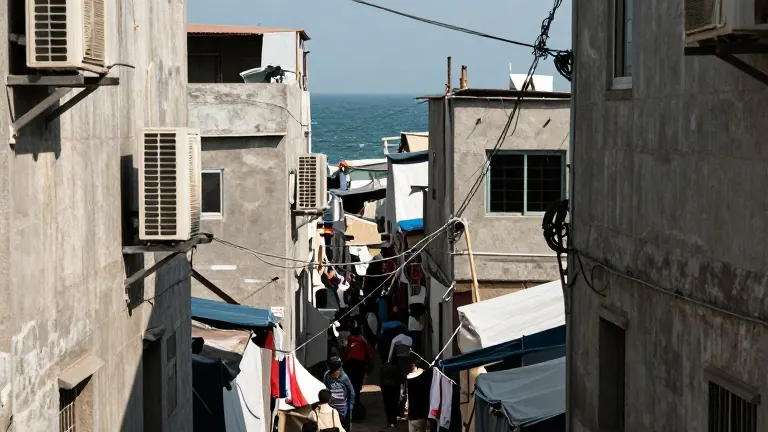
Osama Najjar closed his aluminum shop in the Beddawi refugee camp in Tripoli, Lebanon, in early 2024 after rising electricity bills and stagnant business revenue made it impossible to pay his debts.
Najjar is one of roughly 222,000 Palestinians residing in Lebanon, a group that UNRWA identifies across twelve recognized refugee camps. Many residents, like Najjar, rely on small businesses for income because Lebanese law bars them from practicing medicine, law, engineering, or pharmacy. Although a 2010 amendment to the labor law reduced permit fees and a 2021 decree eased some professional restrictions, experts describe the implementation of these changes as limited. In February 2026, the government introduced a mechanism allowing Palestinian nursing students to apply for employment sponsorship, but structural exclusion from the formal labor force remains a central complaint.
The economic pressure has intensified since the 2019 banking crisis. The Lebanese state provides only a few hours of state-supplied electricity daily, forcing households to depend on private generators. The World Bank projects that domestic inflation could reach 17.5 percent in 2026. These rising costs hit the camps particularly hard, according to Najjar, who cited high prices and electricity bills as his primary concerns. Elia Ayoub, a Palestinian-Lebanese researcher, noted that Palestinians can study for these top professions but cannot work in them, and they remain excluded from land ownership and parliamentary representation.
Aid funding has also contracted. After Israel alleged in 2023 that UNRWA staff participated in the October 7 attacks, several nations cut funding, though UNRWA denied the claims without evidence and many states have since reinstated support. UN Secretary-General Antonio Guterres warned in July of a $100 million shortfall. In September, the agency reported a likely deficit of at least $200 million between late 2026 and early 2027.
With economic conditions worsening, more residents are attempting to reach Europe by sea. The number of vessels leaving Lebanon doubled between 2020 and 2021 and rose by 121 percent the following year, according to the Friedrich Naumann Foundation. At least 86 people died when a boat sank off the Syrian coast in 2022. In late October, the European Union approved a mission to support Lebanese security forces, including maritime security governance.
Najjar said conversations in the camps increasingly focus on boarding boats to reach Turkiye and then Greece. Without immediate economic relief, he said, residents will continue to seek escape by sea despite the risks. "All of this is still because the situation for Palestinians in Lebanon is poor," he said.