European Youth Unrest: France Tally Drops as Protests Spread
French authorities report 320,000 demonstrators nationwide, a decline from prior weekends, while Germany and Portugal join the movement.
By Marco Whitaker ·
European youth movements have expanded their reach across multiple nations this weekend. France hosted its third consecutive weekend of demonstrations focused on living costs and education on Saturday. The event marked a shift in scale compared to previous weeks, with authorities tracking a reduction in crowd sizes while simultaneously deploying heavy security forces.
French Interior Minister Laurent Nuñez described the situation as carrying a "very high risk" of disorder. Government estimates place the nationwide turnout at 320,000 people. This figure is lower than the 500,000 attendees recorded on Oct. 17 and the 410,000 present on Oct. 24. Organizers claim much higher numbers, though official data serves as the primary metric for comparison.
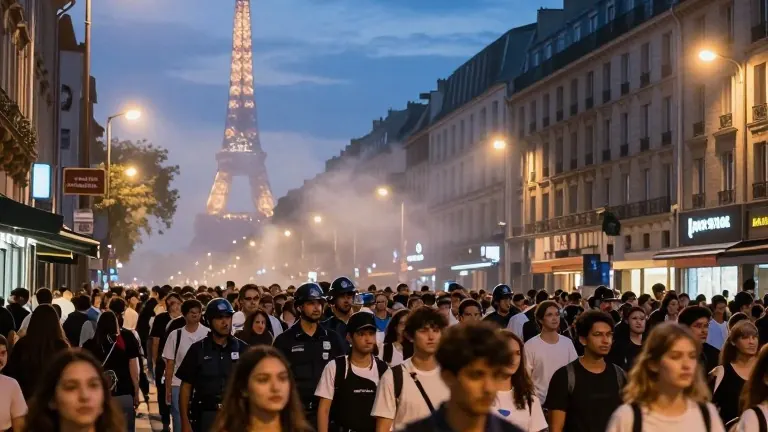
Security operations involved roughly 70,000 police and gendarmes deployed across the country. Parisian authorities rerouted main marches to the city's edge to protect government buildings and tourist sites. This strategic shift followed a last-minute court battle that moved the primary gathering outside the central districts.
Arrests dropped sharply from the previous weekend. Authorities reported about 300 arrests nationwide by Saturday, a decrease from the 800 recorded at the same time last week. The lower number suggests a more controlled atmosphere in many areas, although isolated clashes still occurred.
In Paris, the main march involved an estimated 70,000 people. Participants walked along the Boulevards des Maréchaux, a ring of avenues surrounding the city center. The crowd included high school students, climate activists, and citizens concerned about inflation. The atmosphere remained largely festive for hours, with techno music and painters joining the procession.
Tensions flared near Porte de Charenton as the march concluded. Protesters threw glass bottles and fireworks at officers. Police responded with stun grenades and tear gas. The smoke filled the streets as dusk approached, causing many peaceful marchers to retreat into the nearby Bois de Vincennes park.
The unrest extends beyond France. In Germany, a youth group called "Gen Z regelt" held rallies in more than 30 cities. Tens of thousands participated, demanding investments in education, health, and climate protection. In Berlin, students gathered at the Brandenburg Gate to voice their demands.
German high school student Lara Breitenbach stated that authorities must invest in social services and education because young people will live with the consequences the longest. In Cologne, police ended a march early after protesters used pyrotechnics and threw stones. Similar scenes played out in Hamburg and Frankfurt, where water cannons and tear gas were used to disperse crowds.
Protests also reached Portugal and the Netherlands. In Lisbon, thousands of families gathered in downtown areas to protest the housing crisis. Participants held signs reading "Houses or Fire" and carried small cardboard houses. In The Hague, a strong police presence guarded the shopping district, though major disturbances had not yet occurred by midafternoon.