Serbia removes Vucic after student protests; youth unrest spreads to Albania and Germany
European students are demanding better schools and jobs as rising costs strain young households, with demonstrations now active in multiple capitals.
By Samir Doyle ·
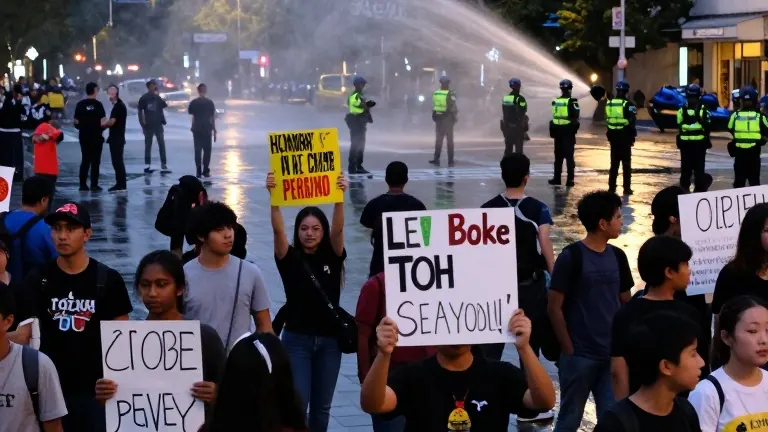
Aleksandar Vucic is no longer Serbia's leader. Student-led protests that began nearly two years ago ended his tenure this weekend. Demonstrators cited corruption and authoritarianism as key reasons for the change.
The shift marks a rare instance where street protests directly altered a government structure in Europe. The movement has roots in a wider wave of youth activism across the continent. Similar demonstrations have occurred in Bangladesh in 2024, Nepal in 2025, and India earlier this year.
Young Europeans are facing specific economic pressures. A 2025 European Union survey found that 40% of people aged 16 to 30 worry about prices and the cost of living. Poverty risk is highest for young adults aged 18 to 24, affecting 26.3% of that group. This compares to 18.8% of adults aged 65 and older.
In France, demographic wealth gaps fuel the anger. People over 60 make up a quarter of the population but own 60% of the country's wealth, according to the OFCE think tank. French pension spending is set to reach 14% of economic output. This figure is lower than Greece and Italy, which spend about 16% of GDP on pensions, but higher than Australia, Chile, Iceland, Ireland, or South Korea, which spend less than 4%.
A French government report from October noted that pension spending rose by 2.5 percentage points of GDP between 2000 and 2023. Education spending fell by 0.5 percentage points in the same period. The report showed that 32% of the education ministry’s budget now goes toward pensions.
Protesters in various cities describe poor conditions in their local schools. Bilal Narjissi, a 17-year-old student in a suburb north of Paris, recalled rats in his school. He said students were evacuated last year after a roof collapsed on the courtyard. In Milan, Chiara, a 21-year-old student, said Italian schools lack enough teachers and have crumbling buildings. She described the job prospects as underpaid and the housing as tiny and overpriced.
Unrest has also reached Albania. Student demonstrations against Prime Minister Edi Rama's government have spread from Tirana to other cities. Xyke Kurti, a 19-year-old architecture student, said her prime minister spent 130 days ignoring student demands. She noted that most students see their future outside the country.
Maya Gourdel, a 19-year-old student in Brussels, said the media only paid attention when protesters began burning trash. She adopted the slogan “If we burn, you burn with us!” from the film The Hunger Games. Stasa Piletic, a Serbian student, said the group feels a sense of victory and responsibility. A demonstration is planned in Germany this weekend. The agenda includes cost of living, inequality, war, and the state of schools. Luka Stojakovic, a Serbian protester, said the group has no governing experience but believes it has seen where political experience leads.