Putin Backs Three-Way Ukraine Talks After Hours of Negotiations With U.S. Envoy
The Kremlin has agreed to restart diplomatic discussions with Washington and Kyiv next month, marking a significant shift in the conflict after weeks of stalled progress and renewed pressure from the White House.
By Samir Doyle ·
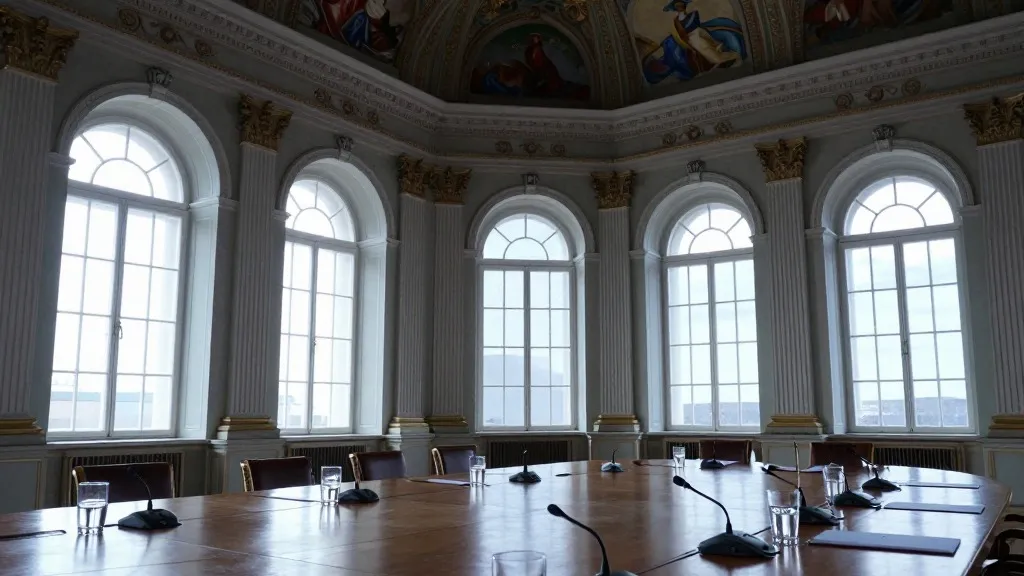
The Kremlin has officially agreed to resume three-way negotiations with the United States and Ukraine next month, a move that could lead to the first substantive talks between the three parties since February. Russian President Vladimir Putin gave his approval in principle to restart the process after November 10, according to Yuri Ushakov, his foreign affairs adviser. This development follows a lengthy meeting between Putin and U.S. envoy Steve Witkoff in St. Petersburg, which lasted approximately three hours.
Ushakov stated that the upcoming discussions will center on creating a security framework for both Russia and Ukraine once the conflict concludes. The decision to proceed comes as U.S. President Donald Trump continues to push Kyiv to accept a deal that halts the fighting. Ukrainian President Volodymyr Zelenskyy expressed support for the rapid restart of talks, noting in an audio message that the agenda is clear: to end the war and prepare for a meeting at the leaders' level. He added that Russia has repeatedly signaled readiness to meet, though past attempts have often been canceled or stalled.
Despite the diplomatic progress, the atmosphere in Kyiv remains tense. Shortly after Zelenskyy issued his statement, a missile alert sounded over the capital, accompanied by loud explosions. The timing underscores the fragility of the peace process, as both sides continue to exchange strikes while diplomats work to bridge their differences. The last three rounds of negotiations, held in Abu Dhabi and Geneva earlier this year, yielded limited results beyond prisoner exchanges, with Moscow and Kyiv maintaining their core demands.
Ushakov criticized the proposals that emerged from a recent meeting in Oslo involving Witkoff, Zelenskyy, and European leaders. He described the Oslo outcomes as containing little real value for resolving the crisis, though he later conceded on state television that they represent a step in the right direction. The St. Petersburg talks involved Witkoff, Ushakov, and Russian presidential envoy Kirill Dmitriev, with Trump's son-in-law Jared Kushner joining via video. A U.S. official familiar with the private discussions said that Witkoff and Kushner proposed a technical-level three-way meeting and shared updates on their prior talks with Zelenskyy.
The discussions in Russia also touched on broader economic issues. Putin indicated he was ready to consider restoring economic ties with the United States and discussed the possibility of using Russia's relationship with Iran to help bring about peace. Ushakov noted that large-scale joint economic projects with significant cooperation prospects were discussed in detail, with some nearing the implementation stage. Additionally, Putin and Witkoff explored the potential for a trilateral summit between the leaders of Russia, China, and the U.S. at an economic event in China next month, with Beijing already preparing for the occasion.
In a gesture viewed as a goodwill move, Russia released a retired American teacher who had been imprisoned on charges of fighting as a mercenary in Ukraine. Witkoff indicated this release followed a request from Trump to Putin to free Stephen Hubbard. Meanwhile, the diplomatic shuttle continued with Witkoff returning to Oslo for consultations with Norwegian Prime Minister Jonas Gahr Støre. Støre suggested that the region may have entered a new phase where Russia is actively seeking diplomatic opportunities, predicting the new talks would likely occur in mid-November.
The pressure on Ukraine to compromise remains high. At the White House on Tuesday, Trump told reporters that he wants Zelenskyy to make a deal, citing the significant resources the U.S. has provided and the lack of tangible returns. He warned that failing to reach an agreement could lead to very bad outcomes. Zelenskyy responded by noting that Kyiv is once again receiving early warnings about incoming Russian missiles, a change from recent strikes that occurred with less notice from allies.
Military actions continued to shape the backdrop of these negotiations. Overnight Russian attacks in Kyiv resulted in three deaths and 12 injuries, with ten residential buildings damaged. Ukrainian Prime Minister Serhii Koretskyi reported that energy facilities in Kyiv and three other cities were targeted. Outside Kharkiv, two people died and 11 were wounded in a drone strike on a residential area. The Russian Defense Ministry claimed its forces struck a warehouse, an electrical substation, and a bulk carrier headed to Odesa, while also reporting the interception of 373 Ukrainian drones over various regions and the Crimean Peninsula.
The release of the American teacher and the scheduling of new talks signal a willingness from both sides to find a path forward, even as the war enters its fifth year. The next few weeks will be critical in determining whether these diplomatic efforts can translate into a lasting ceasefire or if the cycle of strikes and stalled negotiations will continue.
More Politics · Atlanta news · Report a business · Got a Story?