Kendall County’s Cider Economy Powered by Local Apple Strains
Historical records from the 19th century reveal how specific apple varieties, including the Minkler strain, became central to the region’s agricultural output and industrial processes.
By Marco Whitaker ·
Apples served as a primary cash crop and industrial input in Kendall County during the 19th century.
The regional economy relied heavily on fruit production, with specific local strains driving commercial cider operations. John Chapman, known as Johnny Appleseed, established the foundation for Midwest orchards by planting thousands of trees in Ohio, Indiana, and western Pennsylvania starting around 1800. Settlers utilized his root stock for grafting, creating the orchards that would later supply the Illinois prairies. While Chapman’s direct presence was in the eastern parts of the state, his agricultural legacy provided the stock for the fruit industries that flourished further west.
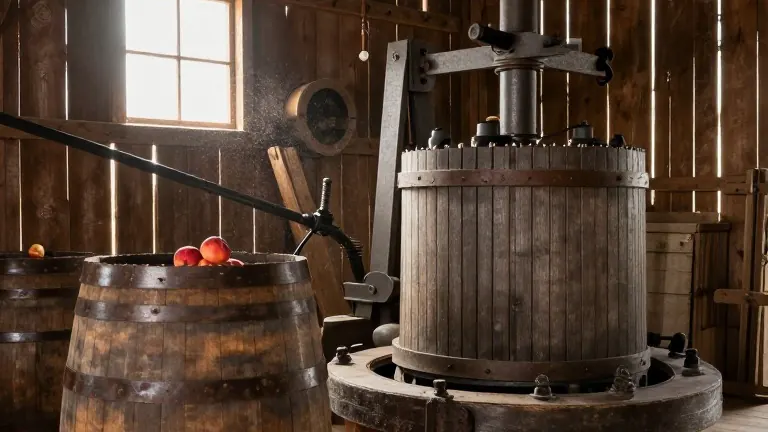
In Kendall County, the focus shifted from raw consumption to industrial processing. Cider was a staple beverage and a safe alternative to contaminated water sources before the widespread acceptance of germ theory. The Kendall County Record documented the scale of these operations. On Aug. 17, 1876, the paper reported that Thomas D. Wayne constructed an engine house for his cider factory and purchased a new press to produce cider on an extensive scale. This infrastructure allowed farmers to convert perishable fruit into durable goods, specifically vinegar, which served as a preservative for other food products.
The Minkler Apple, developed by local nurseryman Ellis Minkler, demonstrated the high yield potential of the region’s soil. The Record noted on Sept. 4, 1889, that Minkler distributed apples weighing one pound each with a circumference of 14 inches. These large fruits proved efficient for pressing. In the fall of 1891, S.B. English extracted 252 gallons of cider from just 50 bushels of Minkler Apples. This high ratio of liquid to fruit made the variety attractive for commercial producers seeking maximum output per unit of raw material.
Vinegar production became a hazardous but profitable sideline for local businesses. The Squire Dingee Pickle Factory in Yorkville consumed large quantities of vinegar, while D.H. Haight operated a vinegar facility in the basement of his Oswego business. Accidents were not uncommon. On Nov. 11, 1891, the Record recorded that Henry Case was rolled over by a barrel of cider while descending cellar steps, leaving him flattened for two days. This incident illustrates the physical risks associated with handling the heavy barrels required for the process.
The abundance of fruit also created social friction. In the fall of 1889, the Record’s Oswego correspondent described how local boys swarmed wagons carrying apples for cider production. The correspondent recounted an incident where a load driven by Chas. Stiefbold lost its end board, scattering apples across a street block. The fruit was quickly claimed by children who filled their pockets and threw the apples at one another. This behavior highlighted the scarcity of other fresh produce and the cultural value placed on the autumn harvest.
Today, the commercial scale of apple production in the county has diminished. Most surviving orchards are untended and produce limited fruit, with few operating as full commercial entities comparable to those of a century ago. A shift toward smaller, farm-to-table operations is beginning to reengage local growers. However, for most residents, pressing cider and making apple butter has transitioned from a necessary economic activity to a recreational hobby. The infrastructure that once supported a major local industry has largely been replaced by modern supply chains, though the historical significance of the Minkler strain and the early cider factories remains a documented part of the county’s agricultural heritage.
More Business · Buyer Beware · Report a business · Got a Story?