
Ancient Bone Yields Dinosaur Blood Cells
Researchers in Western Australia report finding fossilized red blood cells and heme traces in a 115-million-year-old Aratasaurus hind leg bone from Brazil.
By Samir Doyle ·
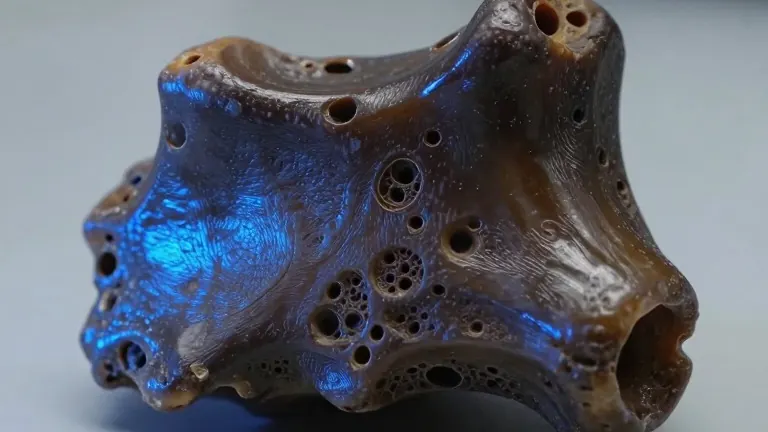
Scientists at Curtin University in Western Australia report identifying fossilized red blood cells in a dinosaur bone from 115 million years ago. The discovery involves the hind leg bones of an Aratasaurus, a small meat-eating dinosaur that lived in what is now northeastern Brazil. If the findings hold up to further scrutiny, they provide direct access to the animal's blood chemistry for the first time.
The team used electron microscopes to examine the bone. Images showed small, round structures inside fine channels where blood vessels once ran. Chemical tests confirmed the presence of heme, the compound that allows hemoglobin to carry oxygen. The researchers also detected traces of amino acids that build collagen, a protein found in connective tissue.
Prof. Kliti Grice led the research team. She stated that the team is seeing a mineral and molecular echo of the dinosaur’s original biology. Grice noted that fossilized red blood cells with distinct heme chemistry have never been found in any fossil before, let alone a dinosaur. She called the finding a world first.
The Aratasaurus fossils were discovered in a mine in 2008. They have been held in the National Museum of Brazil since then. Grice spotted the cell-like structures while analyzing the hind leg bones. She proposes that a manganese compound called hausmannite stabilized the cells and amino acids before they fossilized.
The study appears in the Proceedings of the National Academy of Sciences. The findings are controversial because biological tissues usually break down quickly. However, the preservation of heme and collagen amino acids supports the team's interpretation. Grice said the work does not imply that large biological molecules like proteins or DNA survive in ancient fossils. She emphasized that the aim is to determine how much genuine molecular information deep time can preserve.
Prof. Mary Schweitzer of North Carolina State University is not convinced the structures are red blood cells. She pointed out that dinosaur red blood cells should have a nuclear bulge, making them appear dome-like on both sides. The structures Grice found are concave. Schweitzer was more persuaded by the discovery of heme and collagen. She added that the conventional wisdom in paleontology that all endogenous organics disappear in a million years or less is being routinely challenged.
Grice urged caution regarding other fossil collections. She stated that any extraordinary claim needs extraordinary analytical evidence. She added that extraordinary molecular information may already be sitting in museum collections around the world, waiting for researchers to ask new questions of old fossils.